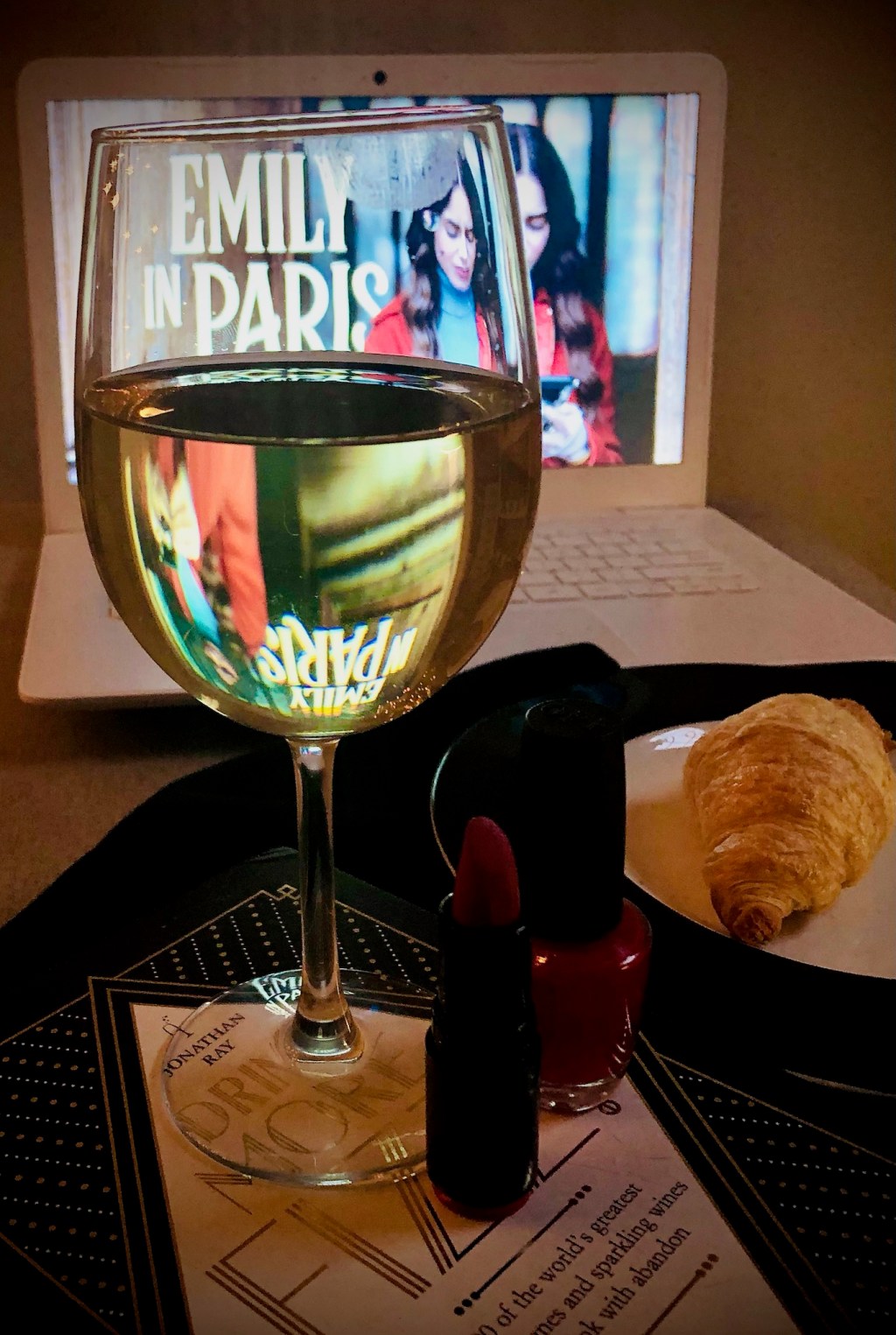
I love to hate-watch Emily in Paris. From the lack of diversity and bad cultural stereotypes to the wildly implausible plot, there’s a lot to hate about this show. Let’s get real: Paris is the second-most multicultural city in Europe–yet, when I’m watching, I can’t help but notice that the majority of people on my screen are white. Who exactly is sending an underqualified, young, American, female employee to Paris, when she does not speak French? She certainly isn’t going to make tons of friends or succeed in business by aggressively not learning French, especially when her attitude seems to imply that her French colleagues are lazy and her American workaholic sensibilities are objectively correct. But, like with a shitty ex-boyfriend, I want to look past all the flaws and red-flags and keep loving this show because all of the awful things about it somehow don’t stop it from being absolutely intoxicating.
Wine comes up in Emily in Paris a lot. Like, a lot, a lot. I actually tried to do a re-watch of seasons one through three and write down literally every time wine appeared or was referenced. I gave up on my note-taking and poured myself a glass instead. So, before I get into suggested pairings for the show, please allow me to get slightly preachy for a moment. Dietary Guidelines for Americans from the CDC say men may drink two or less drinks each day; for women, the approved number is one drink per day. Furthermore, it’s not recommended that you actually drink every single day. Other cultures certainly embrace alcohol differently than western culture. However, I don’t think that Emily in Paris is a healthy model for a relationship with alcohol. It’s not even necessarily a realistic representation of how the French drink. It’s fiction. It romanticizes drinking a lot of wine. Drinking wine is great. It’s one of my favorite things to do. But, it’s important to know that we live in the real world. So, how much we can happily, safely consume on a regular basis in the real-world shouldn’t be modeled after how much Emily (a fictional character) drinks in her highly fictionalized, white-washed, mostly English-speaking version of Paris.
So, if you’ve got an inkling that you’re smarter than Emily of Emily in Paris fame and deserve a work assignment at a French marketing firm more than she does–you’re probably right. I have practiced French on Duolingo for about a year now. While I started off strong and highly dedicated, I’m down to spending less than three minutes on my studies each day. I can speak more French than Emily does as of season three. Armed with nothing but a mediocre Duolingo score and a basic knowledge of French wines and food, I feel like I do a better job at being “Emily in Paris” than Emily Cooper does. (I look cute in a beret; so I’ve got that going for me, too, which is nice.) You can dethrone Emily, too, as the Cole Porter of the 2020s. (Though I’d prefer to think of myself as a modern day Zelda Fitzgerald during her Paris years.) You just need a little bit of knowledge to dethrone Emily Cooper as this year’s coolest American in Paris, and I’m happy to share what I know with you!
In season one, episode one, after first learning about her promotion to the Paris office, Emily walks into a Chicago bar and asks for white wine–something French. Now, the place she’s at is a bit of a dive, so expecting a nice French white wine seems unrealistic. But, here’s a crash course on basic French white wines so that you can sound smarter than Emily Cooper the next time you want to order a glass. First, you should know that France is broken into different regions and different wines come from these different regions. The one region most people know is Champagne; and we know that the bubbly stuff made in Champagne is real Champagne, but the bubbly stuff from other places is ‘sparkling wine’ or some other kind of bubbly. Champagne is only one region in France–there are many more. Next to Champagne, I think Bordeaux and Burgundy are probably the two best known regions–and for good reason. They have excellent wines! An easy white wine to remember from the Bordeaux region is Bordeaux Blanc. (It has the name of the region and the color of the wine right in the name!) This wine is typically made with a blend of Sauvignon Blanc, Sémillon, and Muscadelle grapes. In the Burgundy region, Chardonnay or Chablis are popular white wines. But, just as there are red Burgundy wines, they have white Burgundy, too! If you head towards the southern part of France, you’ll find the Langeudoc-Roussillon region which produces fantastic Langeudoc White Blends. (Another wine with the region and color right in the name. Come on, Emily Cooper: learning this stuff isn’t that hard if you put in just the tiniest bit of effort!) My personal favorite wines probably come from the Loire Valley in France; famous for both Sauvignon Blanc and Chenin Blanc. There you have it. It’s barely a cursory overview of French white wines, but you now know more about white wine than Emily Cooper–and that girl lives in Paris!
Several episodes later, Emily’s fast-won new-bestie says the now infamous line, “This is Sancerre, it’s a breakfast wine.” I laughed at this. My friends didn’t. This caused me to realize this line is only funny if you know that Mindy’s full of shit. Sancerre isn’t a breakfast wine. Wait, that’s not fair, I redact my statement. There are two philosophical schools of thought when it comes to wine: either all wines are breakfast wines or no wines are breakfast wines. (Which school do you belong to?) But, no, Sancerre isn’t specifically a ‘breakfast wine’ any more than cold pizza is specifically a breakfast food. While I’m not above a little sip of something fun with my morning yums, it’s unlikely you’ll ever catch me cracking open a bottle of Sancerre in the early half of the day. It just doesn’t do it for me–or the French, really. Realistically, it’s not typical for the French to drink wine at breakfast time. They also don’t just house croissants and fancy pastries every day, as Emily and her pals would have us believe. These treats are generally reserved for special occasions or weekends. With that said, any occasion is a special occasion if you decide that it is. A day is just what you make of it! So, if like me, you’ve recently ordered a very special French pastry box from your favorite local baker, perhaps you’re curious about how to best pair some French pastries with French wines. Here are my thoughts for what to drink with some delicious French sweets and what to watch while you do it:
- Sauternes and a slice of crêpe cake – Season 1 episode 9: the one where Mathieu takes Emily to his favorite crêpe stand in Paris and they have that grating conversation about crêpes just being ‘thin pancakes’ or whatever. Drink your Sauternes, eat your crêpe cake, and know better.
- Chenin-Blanc with a kouignette – Season 3 episode 1: the one where Emily and Mindy are having breakfast, and then Camille shows up, and Mindy refers to Camille as Gabriel’s ‘boulangerie bitch.’ Typing out that sentence made me feel like I was back in high school and now I most definitely need a nice glass of Chenin-Blanc to remind myself that I’m a full grown adult and don’t have time for drama, thanks.
- Sparkling wine made with Cabernet Franc and a slice of gâteau moelleux au chocolat – Season 2 episode 3: the one where Emily has a shit-show of a birthday party and Gabriel makes her a very fancy chocolate cake. They were going to pair the cake with Champagne from Camille’s family’s château and that’s a super cute choice; but a sparkling red from the Loire Valley would honestly be better. Drink your wine, eat your cake, and be thankful you were able to watch that birthday fiasco unfold from the safety of your sofa because, mon dieu, can you imagine actually being in a situation that tense?! No thanks.
- Demi-Sec Champagne with a pain au chocolat – Season 1 episode 1: the one where Emily clumsily stumbles into somebody else’s dream-life, with little appreciation for the privileged position that she finds herself in, and then struggles with masculine and feminine nouns in the French language (honestly–same, girl) and acts like she’s been living under a rock and has never eaten anything deliciously buttery or chocolatey ever before. (Can’t relate.) Surely, we’ve all at one time or another eaten a really heavenly pain au chocolat that made our knees go weak. Hopefully we all kept our cool better than Emily did upon her first bite. But, I dare you to keep your cool after pairing a pain au chocolat with a Demi-Sec Champagne. I don’t know about you but, for me, all bets are off. Some things taste too good for me to be able to keep up my stony exterior whilst enjoying. Catch me looking like a fool in love all over a delicious pastry and some bubbly.
Alright, now it’s time for the big guns to come out. It makes me nervous, but we can’t talk about Emily in Paris and not mention Champagne. Obviously, a major plot-point of the show is Emily finding a way to market the excess bottles of undrinkable champagne produced by her friend’s parents as a less sophisticated beverage, “Champère.” Named for Camille’s dad, this ‘drink’ isn’t meant to be drunk, but rather sprayed. Shopthescenes.com is now offering a line of Champère clothing, accessories, and, you guessed it, actual bubbly. I’m not sure that I really want to spend $25 on De Lalisse Champère Sparkling Wine; I’m not sure that I’m that brave… or stupid, depending on how you look at it. What I do know is that I love Champagne; but not just to drink, and not to spray, either. I love the idea of Champagne. The history of Champagne. The cultural impact of Champagne. (Do you guys want to hear me talk more about Champagne? I’m kind of passionate about it. If it interests you, drop me a message!) I don’t want to bore everyone with Champagne trivia right now; because maybe you won’t find it as fascinating as I do. I’ll impart only this tidbit of information: when you go to the store and buy a bottle of Champagne, it typically won’t have a year on it. (When it comes to wines, we refer to ‘years’ as ‘vintages.’ So, if you bought a bottle that said 2012 on it; the ‘vintage’ of that wine is 2012. That means the wine inside the bottle was made using fruit harvested in 2012 only.) While it is possible to buy a single-vintage Champagne, most Champagne is non vintage. In order to create consistency of product, cellar masters blend various vats from multiple vineyards and/or vintages. This is why the standard Moët & Chandon that you (hypothetically speaking) grabbed for New Year’s Eve in 2022 tastes basically identical to the bottle of Moët & Chandon that you grabbed for New Year’s Eve in 2018. With that said, that means that there’s several years of grapes inside one single bottle of Champagne. So, if you follow the “spray it, don’t say it,” philosophy of Champère, then a Champagne shower, in a way, is like a bukkake of history. (I know that’s a bit crass but I’m not sorry I said it. I find myself to be quite charming.)
So, if you’re going to drink while watching Emily in Paris, I think there’s only one rule: make sure it’s a French wine. With the miniscule amount of information on French wine in this blog post, you already know more than Emily Cooper does about French wine. You could probably get hired by Madeline at Savoir; Sylvie’s hiring standards are likely a little more exacting. So, whether still or sparkling, avec une pâtisserie ou sans, white, red, or rosé, (Oh là là, France has some of the very best rosé wine!) you may not be a French wine expert quite yet, but babe, you’re doing better than Emily Cooper. Somebody ought to give you a nice trip to Paris!


 Plonk & Pleasure
Leave a reply to Lauren/wallaby knits Cancel reply