
I love French food. It’s special, bordering on magical. There’s something astonishing about simple ingredients transfigured to become greater than the sum of their parts through skillful technique. An ordinary chicken becomes extraordinary, elegant even, when prepared with French style. When it comes to la cuisine française, an emphasis is always placed on quality ingredients, fresh produce, and an abundance of herbs. Then, of course, there’s my personal holy trinity: bread, butter, and wine. I really do love it–maybe more than any other type of food. But, it’s not just me: culturally, we indisputably hold reverence for French cuisine. So often, when a new restaurant opens, you’ll hear the food described as a particular region’s cuisine but prepared with French technique–as if that somehow improves upon what a culture of people has already perfected over their history. Some may argue that this imperialistic approach to cuisine is because of racism. Some may argue that it’s because French techniques are so widely popularized in cooking schools that other cultures’ approaches to food are seldom, if ever, taught. While I’d love to delve into the dubious ethics of it all–now is not the place nor the time. Because, ultimately, even if our obsession with French technique is perhaps morally dubious, there’s no avoiding the obvious: the resulting food is fucking delicious. Do you know when I enjoy French technique the absolute most? When it’s applied to traditional French cuisine. Talk about right place right time.
While one of my biggest complaints upon moving to Fort Wayne was the lack of representation for traditional French bistro cuisine in the food scene, I’ve been presently surprised to see this gradually shift since my arrival. Most recently, I was completely spoiled by Junk Ditch Brewing, who opted to craft a French inspired menu as part of their Monday night tasting dinner series. These dinners absolutely never disappoint: so my hopes were sky high when I arrived for dinner with a small group of mes amis. As I write this, the moon is high in the cloudy sky, there’s still a black beret perched upon my head, and I’m spooning mouthfuls of warm leftover Pommes Aligot from a plastic pint. (Thank you, Chef Andrew, for the princess treatment–not just for me, but for the whole table. Aligot to go!) I’m painfully aware that sometimes things are sweeter in memory. However, I do believe that the reality of my meal this evening has not yet been colored with the passing of time–lightly warmed in the microwave, the Pommes Aligot remain divine still. Was this the best meal I’ve ever had at Junk Ditch? Perhaps, perhaps, perhaps.
Our meal began with an amuse-bouche of mushroom gougères. For those unfamiliar, think of a savory cream puff. Instead of a fluffy, sweetened cream filling, the Pâte à Choux puff encapsulates a mushroom duxelles of sorts–still relatively creamy in texture, but supremely earthy instead of sweet. They were served up gorgeously piled on a long plank. There were enough that everyone at the table was able to enjoy two puffs: which is, frankly, more than generous for an amuse-bouche. This is a bite I will crave in the days to come–weeks, months, perhaps even for the rest of my life. When a meal starts on such a strong note, there’s a lot of pressure for the following dishes to not simply be equally stunning, but to surpass that first bite in deliciousness. Nobody can accuse the team at Junk Ditch of not knowing how to expertly craft a menu.
Our first course was Lentil Soup with herb oil and thyme. Based only on the menu description, I think we all expected a chunky, lentil filled soup. What we received was a velvety, puréed soup drizzled with bright green herb oil and flecks of thyme. To pair, the Chateau Fage Blanc Bordeaux. This pairing was exceptional–and I honestly don’t think I’ve ever been so blown away by a wine and soup pairing. The bright citrus, pear, green apple, and honey notes of this wine balanced the herbaceous and earthy lentil soup. This felt like a love letter to French cuisine: simple ingredients showing their true selves and blowing everyone away in so doing. The humble lentil finally had that moment from an early 2000s rom-com that we’ve all been waiting for; Junk Ditch took the lentil’s glasses off and–oh là là! Who knew the lentil could be so sexy?
The salad course was, unsurprisingly, delicious. Endive and Radicchio Salad with Roquefort, ham, walnuts, and tarragon vinaigrette. There was also a citrus element–perhaps dried nectarine–I won’t pretend to know when I really have no clue. But, it added such a lovely, bright, acidity to the salad. I personally love balancing tarragon with citrus, like orange, so this was a welcome flavor profile. The earthy, buttery crunch of walnut. The salty bite of ham. The funky, creamy, decadent bursts of Roquefort. All flavors in bed and having a fun time with peppery arugula and just slightly bitter radicchio. To pair, a pale lemon sip of Roche Guilhem Jurançon Blanc Sec. This ultra silky wine gives off oodles of orchard fruits and made the salad course seriously dreamy. Give me a glass of this and I’ll always, happily, eat my vegetables.
I will say, unapologetically and emphatically, that the third course of the evening was my absolute favorite. While, perhaps, the most traditional in preparation–the Sole Meunière with brown butter, capers, Pommes Aligot, and parsley was a distillation of what makes French cuisine so intoxicatingly delectable. Perfectly flaky, tender fish in a sauce of nutty brown butter and salty capers sat upon a heaping bed of cheesy, creamy Pommes Aligot. For those not in the know, Pommes Aligot is somewhere between fondue and mashed potatoes. If that made you say, “Yuck,” I retract the statement and simplify my explanation to: they’re basically just the best cheesy mashed potatoes you’ve ever had. This is the plate that I want daily. This is the plate that I would never, ever tire of eating. It was nicely paired with the Bouchard Aîné & Fils Chardonnay. This Bourgogne white wine is an easy sip, with characteristics of oak and light, crisp notes of pear, green apple, and stone. While I loved the pairing: I would never sip a Chardonnay again if that was the price I had to pay for filling the rest of my days with Sole Meunière. I’m serious. This might be the biggest compliment I’ve ever paid anyone.
The next plate was Pork Pâté. I am a girl who unapologetically loves pâté. I just ate some two days ago. I have some in my refrigerator as I type this. I’ll probably be eating more pâté in the coming days. Genuinely, I can’t get enough of the stuff. If you give me some crackers, or toasty bread, and a bit of pâté: I will gaze at you lovingly like there’s no other person on this planet as gorgeous and special as you are. This plate was slightly unlike other pâtés that I have enjoyed. Served with cornichon, beets, mustard, and microgreens–the portion was hefty, the texture dense, and the flavor was bombastic. To pair, the Louis Bernard Côtes du Rhône Rouge. I believe this is a red blend composed of primarily Grenache; but don’t quote me. I like wine, but I’m no sommelier. And, ultimately, unless you’re a total wine snob you probably don’t care what grapes the wine was made with–you just want to know how it tastes. (I like that about you. No snobbery. Just brass tacks and wine love. Good for you.) Think black currant, plum, and a hint of licorice. Definitely not a heavy red or aggressively tannic. An enjoyable sip, for sure.
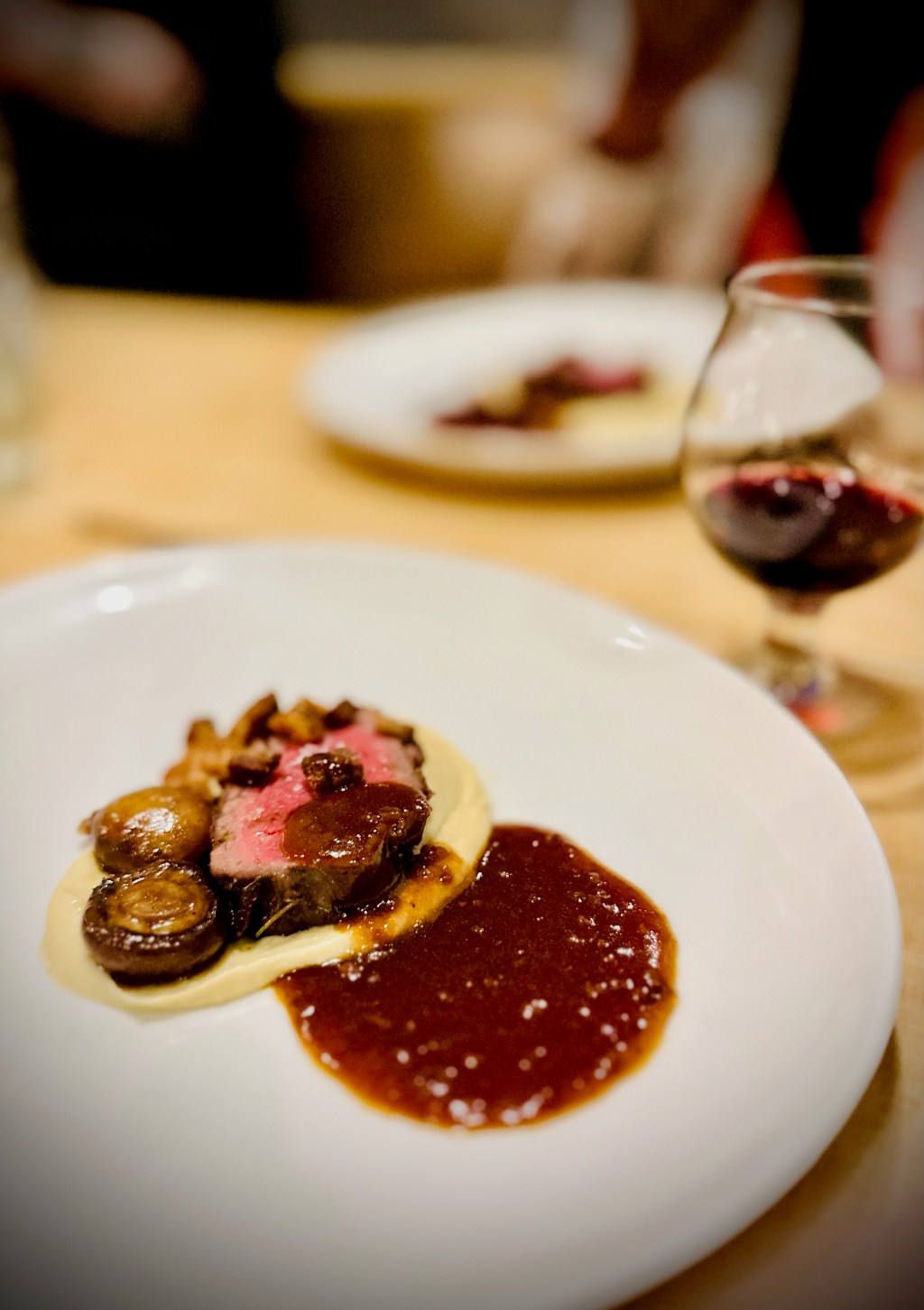
As if we weren’t already thoroughly well-fed and completely spoiled by our meal, the final savory plate of the evening was aged strip steak, parsnip purée, mushrooms, and bacon lardon. The aged strip steak was cooked to rosy pink perfection. So tender: no steak knife needed. The sauce served with it–which, to me, resembled a classic, French, red-wine-based Bordelaise–was heavenly. This all sat above a bed of surprisingly sweet, whipped parsnips. I enjoyed the contrast between the deep umami-rich mushroom caps, crisp bacon lardons, steak with decadent sauce and the creamy, slightly sweet parsnips. To pair, the Château Larose-Trintaudon Cru Bourgeois Bordeaux. When somebody wants a big, bold French red wine–this is it, fam. Blackberry, cherry, leather, and spice: I would sip this again, happily, especially with a nice, aged strip steak.
For our dessert course, chocolate tart with raspberries, Chantilly cream, and a quenelle of lemon thyme sorbet upon a bed of oat crumble. This was, perhaps, one of the best desserts I’ve had in quite awhile. Especially after a multi-course meal of stunning quality, the dessert has to be really exceptional in order to be memorable. Simply being passable isn’t enough–if the dessert isn’t phenomenal, it pulls down the tone of the whole meal. This dessert did exactly what it needed to do and exalted all the remarkable plates that came before it. A crisp, butter tart shell encased a decadent, utterly luxurious chocolate filling. Upon the bed of chocolate, perfect ripe raspberries perched–dotting the circumference of the tart. The lemon thyme sorbet was exceptionally sharp, but was balanced by the oat crumble and served as a refreshing balance to the decadence of the chocolate and raspberry tart. Though, perhaps I’m an outlier, because I didn’t feel the tart needed to be balanced–I would take that chocolate tart to the face, fearlessly, without a glass of water. And I’d do it happily. Of course, I was spoiled and didn’t need to, because not only was there refreshing sorbet, but there was also wine to pair. With dessert, I enjoyed a glass of VillaViva Rosé Cotes De Thau. I’ve enjoyed this wine before–it’s an absolutely lovely little sip. Given the notes of strawberry and raspberry, I can see why it would make sense with this dessert course. It’s a pretty light wine, so I feel like the chocolate perhaps overpowered some of its more subtle nuance–but, that’s not to say that I didn’t enjoy the pairing. A chocolate raspberry tart, lemon thyme sorbet, and a glass of rosé–what’s not to enjoy? This is my idea of paradise.
I was in love with French cuisine before I sat down at dinner. So, perhaps, I am biased. But seldom is a meal so good that the morning after, and even for days to follow, it lingers in my memory like a haunting refrain. Maybe it was the company. Maybe it was the wine. Maybe it was the Pommes Aligot. I’ll never know the exact moment that it occurred, but I can attest that my meal at Junk Ditch transformed my love for French food into something stronger. What’s stronger than love? If I say that the memory of this meal is something I will forever cherish: is my point clearly made? If I tell you that I am burning with a passion ignited anew for la cuisine française, will you understand? Apparently, sometimes it’s not just simple ingredients that are transformed in the culinary process. Sometimes, the experience is so entirely magical that the diner is transformed, too.
 Plonk & Pleasure
Leave a comment