
“In the lea of a picturesque ridge lies a small, unpretentious winery, one that pampers its fruit like its own babies.” Many of us have heard this quote before (and then proceeded to nearly pee our pants laughing) but how many of us have been to a winery that was both picturesque and unpretentious. Unfortunately, snobbery and wine often seem to go hand in hand. It’s something that I have many strong feelings about, but I’ll save that tirade for another day. For those of us who love wine, but not the hoity-toity pretense that accompanies it, there is hope. Country Heritage Winery in LaOtto, Indiana offers a picturesque winery, situated on a small vineyard, with none of the pretense.
I was fortunate enough to score tickets to the Winemaker’s Barrel Tasting. After being waitlisted, I received a phone call that there’d been a cancellation and I would be able to attend. At roughly $50 a ticket, this wasn’t an experience I was willing to miss out on. Prior to this tasting, I’d never been to Country Heritage Winery. I’d gotten a few of their bottles from the store, so I had some limited experience sipping some of their offerings in the comfort of my own home, but I had no idea what to expect from the winery. I dressed for a wine tasting which, in my mind, requires something more than what you might wear to the grocery store. Upon arrival, I found myself devastatingly overdressed. Blue jeans seem to be the dress code of most patrons and, given the rustic wood interior and back room full of taxidermy, blue jeans are appropriate for this location. The vibe at Country Heritage is thus: you’re going to drink some amazing wine and you’re going to feel comfortable doing it.
A small group of us gathered in a hallway flanked with accolades and awards that the winery had received. There, we waited in hushed anticipation of what the evening would bring. The tasting was meant to start promptly at six o’clock, which it did. Not dissimilar to the famous scene from Willy Wonka and the Chocolate Factory where Gene Wilder flings open the gates with youthful exuberance and ushers in the lucky golden ticket holders, at six o’clock the doors to the barrel room were opened for our lucky few. As our group filed into the barrel room, we were told what to expect from the evening, what wines we would be trying, and were first introduced to the winemaker himself. Kevin was born and raised in Indiana and makes all of the wines for Country Heritage. He has an amazing nose and can, reportedly, tell if anything is slightly off in one of the fermentation tanks upon simply walking into the room. He will notice the smell and then need to check each individual tank to assess where the smell is coming from and what the cause may be. His philosophy for winemaking is simple and admirable: grow a good grape and let the wine make itself. He was also adamant about one thing that our tasting experience would not be: pretentious. Needless to say, I liked Kevin immediately.
From the Barrel Room, we were ushered into a second room: the walls flanked high with bottle upon bottle of wine. The room, at capacity, could hold 2,557 bottles of wine. On this particular evening, it held somewhere roughly in the vicinity of 2,000. All the bottles in the room were considered ‘reserve’ bottles and would, typically, not be on offer for tasting at the winery. Among the varied array of bottles were two bottles of an oak aged Chardonnay that we did not get to taste. As I understand it, only those two bottles remain at the winery and, according to all who tried it, it was one of the best Chardonnays they had ever sampled. The French oak barrel it had been aged in cost over $1,000 and was sold after this small batch of Chardonnay was made: there were only ever about 300 bottles in circulation. They didn’t know how spectacular it would be until it had finished aging. It made me wonder what other spectacular bottles I was standing in the company of.
In this room, we had our first sip: the 2022 Traminette. This was paired with vegetarian spring rolls. The wine had just been bottled recently. Roughly 1,000 were made. Unfortunately, due to a “deer infestation,” half of their normal crop yield of Traminette grapes was lost. Typically, somewhere between 2,000 and 3,000 bottles would be made: but we’ve learned that deer like ripe Traminette grapes as a nice afternoon snack. For this variety of off-dry white wine, all the grapes used are local and were grown in Steuben County, located in the northeast corner of Indiana. Supposedly, you can see Michigan from the Vineyard. This wine was slightly floral and would pair nicely with any spicy food.
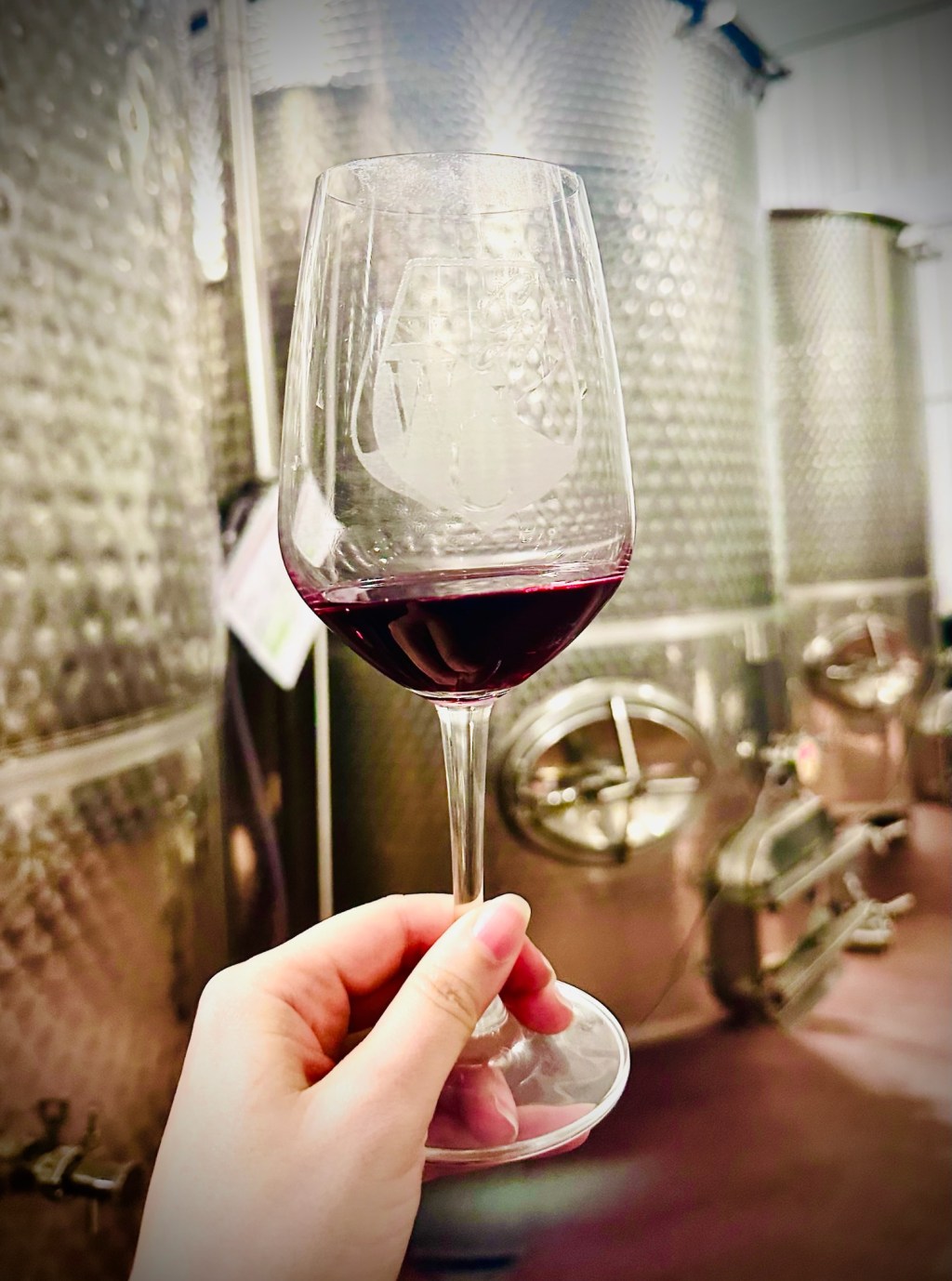
We next entered the production room: a mammoth corrugated metal-type building with massive stainless steel tanks, palettes stacked high with cases of wine, a wall lined with oak barrels, and an intricate looking bottling machine. It was here that we had a taste of Frontenac Blanc with a bite of ceviche. This dry white wine was refreshing, with a nice crisp, citrusy bite and we drank it straight from the tank.
A recent addition had been added off of the production room: with smaller vats and fewer palettes, but still very similar to the production room. Here, we had our glasses filled from a small tank of Cab Franc. This wine had spent roughly fifteen months on oak and was set to be bottled in about two weeks; it’s expected to yield around one thousand bottles. The grapes were purchased from Washington. Cab Franc is very popular in Washington. Country Heritage was only able to purchase a ton of these grapes: so a thousand bottles is all that it will yield. The oak on this wine was subtle and lovely. Paired with charcuterie and Gouda cheese, this was my favorite wine of the evening.
We returned to the production room to sample a very young wine: a wine truly not ready for drinking. This was meant to be part of a learning experience – giving us something to compare and contrast the other wines we tried, that had been aged longer and were closer to being ready for bottling. This brand new Petite Pearl had only been racked once. In age, it was only about four and a half months old. Per Kevin, this wine wouldn’t be ready for bottling until about 2025. It was dry and fruity: simple. It lacked nuance. It was closer to a fancy grape juice than good wine. But, paired with a BBQ Chicken Pizza, it was more than palatable. Having never before been able to sample a wine so early in the process of creation, I was enamored with this tasting. While I certainly wouldn’t want to drink a bottle of young, unfinished Petite Pearl, a few little mouthfuls was a truly exciting experience!
From here, we made our way back to the gorgeous barrel room, where Kevin used an interesting little tool called a Wine Thief to give us all a small taste from one of the oak barrels. The 1231 Red Blend was very tannic and robust: which you might expect from a wine that’s 45% Cabernet Sauvignon, 45% Merlot, and 10% Cabernet Franc. This wine isn’t for the faint of heart or those who only dabble with the idea of enjoying a big red wine. They offered stuffed mushroom caps with this but Kevin said he enjoys it more with a nice steak; and I, too, would prefer this wine with a steak.
Kevin admitted to our small group of eager tasters, “I like food just as much as I like wine; especially together.” Honestly, me too, Kevin. With that said, while the food pairings to accompany the wines were certainly thoughtful, they were very much secondary to the wines themselves. At a wine tasting, perhaps that’s exactly how it should be. Sommeliers will tell you that a truly terrific pairing of food and wine should create a new flavor in your mouth. I wouldn’t say that I experienced that with most of the foods sampled tonight. But, what the foods did do is elevate the wines: bringing out the best in what we were sipping and making subtle notes a bit more obvious to the, perhaps, more inexperienced tasters.
I think that when many of us hear the words “wine tasting,” images of snobbish people sniffing, swishing, and slurping glasses of wine come to mind. Perhaps we imagine self-important people perched at white cloth clad tables discussing ‘notes’ of vanilla, or silky tannins, or any number of silly descriptive phrases that, to the inexperienced wine drinker, may sound incredibly intimidating. The Winemaker’s Barrel Tasting at Country Heritage eschewed this cliché entirely and provided guests with a behind the scenes tour. We spent time where the wine is actually being made, drank glasses poured straight from the tanks, and had a direct interface with the winemaker himself – who was beyond gracious and knowledgeable – and provided us with thoughtful, intimate knowledge of the winemaking process from vine to glass. If picturesque and unpretentious is what you want out of a winery, I can’t recommend Country Heritage Winery highly enough. Often, I find that small, local wineries produce mostly sweet wines – this remains true for Country Heritage, with a large percentage of their bottles falling between off-dry and sweet. At the tasting, I learned that there are more than a few true gems crafted by Country Heritage to satisfy those of us who, like me, and like Kevin the winemaker, prefer our wines on the dryer side. I can say with complete sincerity, I intend to don a pair of blue jeans and head back to the winery as soon as possible. Five samples was plenty for a single evening of tasting, but not enough to satisfy my curiosity entirely. If the wines I sampled tonight were any indication, Country Heritage has a lot to offer. I need to try more; and I simply can’t wait!
 Plonk & Pleasure
Leave a comment